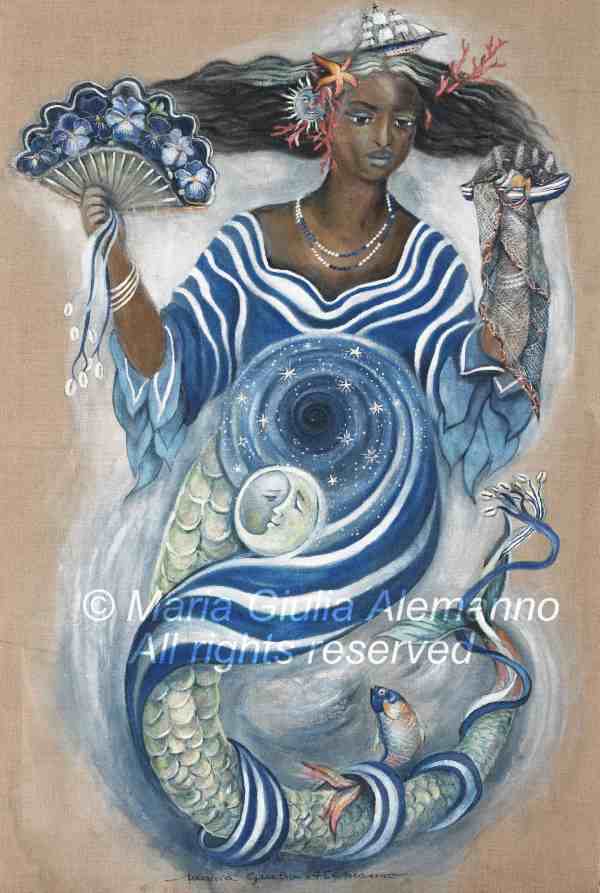
YEMAYA by MARIA GIULIA ALEMANNO © tempera and acrylic on jute 70,9″ x 45,3″ – 2004
Please click LE OPERE of this site for a gallery of her artworks.
Vie des Arts
MARIA GIULIA ALEMANNO
September 19th – October 3rd 2005
Beaux Arts David Astrof
Thomson House
3650 Mc Tavish
Montreal
For the first even Canadian showing of Italian artist MARIA GIULIA ALEMANNO’s paintings, Beaux-arts David Astrof has brought together an unusual body of work. In a sense these large scale paintings share something in common with Stanley Spencer, for the carry of signs and symbols of religion though their emphasis is on the art. The similarities however end there. Maria Giulia Alemanno embody the persons of the Orishas from the Santeria religion. Her visual interpretations are part imagined and part based in this religion centered in Cuba, Brazil and other parts of South America.
The Orishas, considered to be the emissaries od Olodumare or God are believed to have power sto rule over the forces of nature and humanity. This in and of itself makes Santeria interesting as a religion for the forms, the occurrences and elements in nature are literally configurations of these Orishas. For Alemanno, Santeria has invaded her soul, and as she comments: ”if my Orishas can take form here among these fields (in the Italian countryside) it’s because the soul of Caribe has deeply invaded my heart to make me a continuous presence in its waves, its coral reefs, it’s skies”.
When she first starter to make watercolours renditions of the Orishas after a visit to Cuba (where she first learned of santeria) this folkloric religion with such an attachement to the importance of color, costume and dance attracted her like a magnet. Since then Santeria has taken Alemanno on what she refers to as “an infinite journey.” The first exhibitions she held in Italy have been followed up by exhibitions in Havana at St. Francis Orula Abbey, in the restored heart of the old town, and at el Taller del Papel Artesanal and the Sala Mercedita Valdés of the Yoruba Society. Alemanno’s interpretations of the Orishas were likewise shown during the 8th Meeting of Social and Cultural Anthropology on Afro-American roots, dedicated to Fernando Ortiz.
As paintings these works illustrate this religion. They become embodiments of stories of the woods and the seas, of the bushes and trees, and of men and gods that are every bit as epic as the ancient Greek stories of Homer and equally as nature-sensitized as any ecologist’s. Ochun, a great beauty in this religion is painted by Alemanno and carries symbols – a heart with a arrow –a bell and a fish. Dressed in a flowing dress Ochun is accompanied by an image of the sun and peacock feathers – all overt symbols associated with beauty. The painterly collaging cntinues with Yemaya considered mother of water and life. The allegorical style is attractive for its simple and forthright intertwining of sea imagery. A boat, for instance – the old masted sailing kind – rides on waves that are the goddess hair. This merwoman’s very clothing becomes an embodiment of the sea. Chango, the Santeria king of blood and fire is vividly portrayed in red clothing breathing fire, with his machete, sword and rooster – a formidabile and fear-inspiring protagonist. Eleggua, a tiny sprite-like figure with magical powers who is said to open doors has a kite flying in the air beside him. There i san atmosphere of serendipity and chance to this. He is clothed playfully, has a mask and carries a walking stick.
What makes Alemanno’s interpretations so revealing is that they are her very own readings of what these orishas represent. She does not copy other peoples’ visions or renditions of these highly personalized Gods. In so doing the artist communicates to us, just as the dance and music that are part of Santeria, something of that homegrown sensibility and cultural vitality. With color and cadence, these vividly charged depictions intuitively communicate the lively wisdom, the living traditions, often unrecorded in written form, and kept alive through the vernacular of the Santeria religion whose fusion of woodoo and christianity, even ancient Yoruba African culture feels strangely post-Modern for all its hybridity!
Maria Giulia Alemanno’s solo exhibitions dedicated to the Orishas and their world:
2003
De Gregory Palace – Crescentino (Vercelli), Italy
Rubatto Palace – Chivasso (Turin), Italy
G. Secreto Library – Cigliano (Vercelli), Italy
Freidano Museum – Settimo Torinese ( Turin), Italy
2004
St. Francis Abbey – La Havana,
Taller del Papel Artesanal – la Havana
Mercedita Valdes Gallery , Yoruba Society – La Havana
2005
Alejandro de Humbold Museum – La Havana, Cuba
Thomson House – Montreal, Canada
2006
Villa Burba – Rho (Milan), Italy
Luigi Pigorini Museum -Rome
2007
Obrapia Museum – La Havana
Morro Cabaña Fort – La Havana
National Institute of Anthropology – La Havana
Concha Ferrant Gallery- Guanabacoa – Cuba
Ferrari Institute – Cigliano (Vercelli), Italy
Primavera Palace – Terni, Italy
2008
Unión de los Artistas y Artesanos Cubanos – Matanzas, Cuba
2010
Casa de Africa Museum – La Havana
Performances:
ENTRE TIERRA Y CIELO, with set-designer Gino Pellegrini, Plaza Vieja, La Havana
5 ORISHAS EN CALLES MERCADERES, in cooperation with the artists of the Taller del Papel Artesanal, La Habana
Translate »
Interesting Posting
Genial dispatch and this mail helped me alot in my college assignement. Say thank you you as your information.